
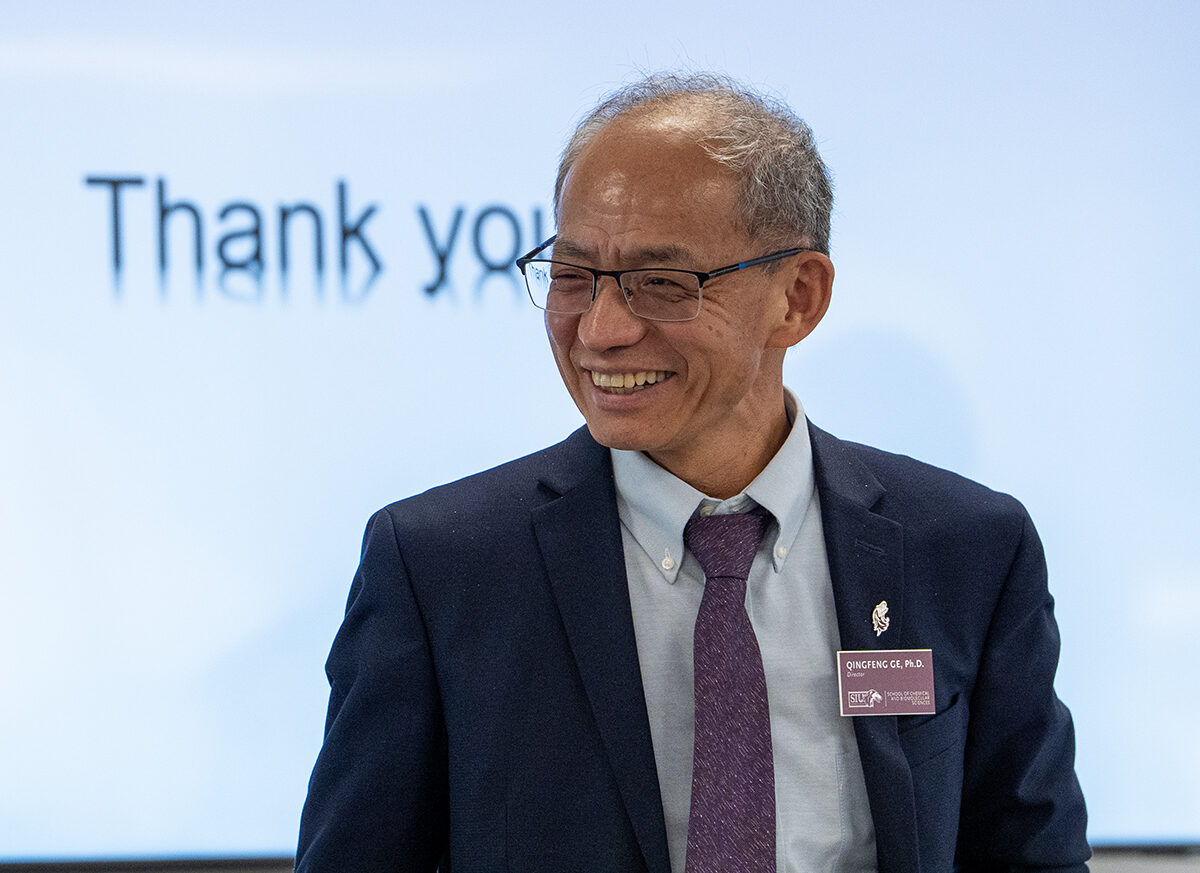
Southern Illinois University Carbondale has named Dr. Qingfeng Ge the inaugural Gower Distinguished Director of the School of Chemical and Biomolecular Sciences, establishing the first named directorship in the College of Agricultural, Life, and Physical Sciences.
Announced during the 20th anniversary celebration of the Gower Fellows Program Annual Symposium in September, the appointment recognizes the longstanding generosity of Dr. Bob and Beth Gower to SIU Chemistry while providing additional resources to advance faculty research, student opportunities and academic excellence.
“We are grateful for Bob and Beth Gower’s foresight and believe it is fitting that Qingfeng is the college’s first named school director,” said Kristina Boone, dean of the College of Agricultural, Life, and Physical Sciences. “We hope this appointment paves the way for future named directorships and professorships.”
Ge, who has led the school since its reorganization in 2021, reflected on the significance of the appointment.
“I consider this appointment both an honor and a responsibility to carry forward the Gower family’s legacy, advance research and support the success of our faculty and students,” Ge said.
A lasting investment in SIU chemistry
Bob Gower, a West Frankfort native, earned bachelor’s and master’s degrees in chemistry from SIU in 1958 and 1960, respectively. Mary Beth Gower graduated from SIU in 1961. Bob went on to serve as president, CEO and chairman of Lyondell Petrochemical Co. and later co-founded Carbon Nanotechnologies Inc. with Nobel laureate Richard Smalley. He also founded Ensysce Biosciences Inc. in 2008.
The Gower family’s commitment to SIU spans more than four decades, beginning with its first recorded gift in 1982 and first endowment in 1989. Since then, the family has invested in scholarships, research fellowships, laboratory improvements and academic programs, including the Gower Research Fellowship, which celebrated its 20th anniversary in September.
In 2024, the Gowers committed $2.5 million to advance research across campus. SIU renamed the McLafferty Annex the Gower Translational Research Center in recognition of their generosity. The center supports collaborative research and connects scientific discovery with real-world applications.
The directorship builds on that legacy by providing flexible funding to support the school’s evolving needs.
“This endowment provides the director with greater opportunities to support faculty success in research, teaching and professional development,” Ge said.
Ge plans to use the resources to strengthen faculty recruitment, provide research startup support and expand student opportunities. The school’s goals include growing its graduate student population to approximately 50, supporting about 15 research-active faculty members and increasing undergraduate enrollment.
“Investing in human potential creates a lasting impact that extends far beyond what we can see immediately,” Ge said.
The family’s philanthropy has also addressed critical needs. The Gowers contributed $75,000 toward organic chemistry teaching laboratory improvements, bringing the total to $150,000 with university matching funds. During Illinois’ state budget impasse, they provided financial assistance to help the chemistry department maintain operations.
Ge explained the family’s commitment extends beyond financial support.
“They give their time and take a personal interest in our students and faculty,” Ge said. “They return every year for the symposium to meet the students personally, hear the fellows present their research and see firsthand what their support has made possible. Those personal connections have had a lasting impact on our students.”
The Gowers’ continued involvement, including their participation in the fellowship’s 20th anniversary celebration in September, has strengthened their relationship with SIU faculty and students, including Ge.
Building on a career of scientific discovery
Ge joined SIU in 2003 after completing his education in chemical engineering in China and holding research appointments at the University of Copenhagen, the University of Cambridge and the University of Virginia. He became a full professor in 2010 and assumed a departmental leadership role in 2019 before becoming director of the School of Chemical and Biomolecular Sciences following its reorganization in 2021.
His research focuses on computational chemistry, catalysis and sustainable energy, including hydrogen storage and converting greenhouse gases into useful chemical products, and has been funded by DOE, NSF and other sources. His team’s prediction that indium oxide could effectively catalyze the conversion of carbon dioxide into methanol was later confirmed experimentally by Javier Pérez-Ramírez’s group in Switzerland. Ge was recognized by SIU’s Scholar Excellence Award and the American Chemical Society’s Midwest Award in 2018 for his research achievements.
Ge’s relationship with the Gower family began through his DOE-funded hydrogen storage research, which connected him with Bob Gower, who facilitated Nobel laureate Richard Smalley’s visit to SIU in 2005. Ge has since helped organize the annual Gower Fellows symposium, witnessing firsthand the family’s impact on students and faculty.
The School of Chemical and Biomolecular Sciences plays an important role in SIU’s Research 1 designation through the quality of its research, funding and scientific contributions. The school also emphasizes undergraduate research opportunities, connecting students with faculty and laboratory experiences early in their academic careers.
The Gowers’ investments support SIU’s commitment to research excellence and educational opportunity. Among approximately 4,000 colleges and universities nationwide, SIU Carbondale is one of only 21 to hold both the Research 1 and Opportunity University designations under the Carnegie Classification of Institutions of Higher Education. SIU is also the only institution with both classifications serving a rural region.