
By Britni Bateman
Dr. Mark and Susan Ashley came to Southern Illinois University as graduate students with a shared interest in speech pathology and left with an education that shaped both their careers and their commitment to giving back.
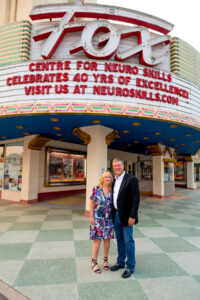
That commitment now extends far beyond Carbondale. The Ashleys are the founders of Centre for Neuro Skills, a nationally recognized provider of post-acute brain injury rehabilitation. Through their business success and philanthropy, they continue to strengthen SIU by supporting faculty excellence, student opportunity, and innovation in the field that launched their careers.
“We were happy with our experience at SIU,” Susan Ashley said. “I feel like I got a great education.”
From graduate students to innovators
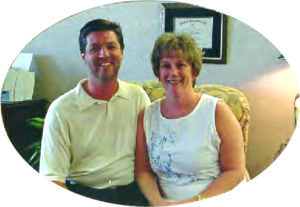
The Ashleys met as children, dated in high school, and married after their first year of college. Both pursued undergraduate studies at the State University of New York at Geneseo before entering graduate programs to prepare for careers in speech pathology.
A visit to Carbondale proved pivotal.
Faculty members in SIU’s Communication Disorders and Sciences program welcomed them, introduced them to hands-on research, and demonstrated how interdisciplinary learning could expand their impact. Dr. Mark Ashley said the environment encouraged curiosity beyond a single discipline and supported collaboration across departments.
“That kind of thinking stays with you,” he said.
Graduate school was demanding. The Ashleys carried heavy course loads and worked multiple jobs to finish their master’s degrees in four semesters.
“We didn’t have a lot of money,” Dr. Mark Ashley said. “If we weren’t in school, we were working.”
Those years built both professional discipline and a lasting appreciation for the mentors who invested time and resources in them.
A business rooted in purpose
Dr. Mark Ashley’s professional path was shaped by personal experience. His brother suffered a severe brain injury while serving in the Navy, exposing him early to the long-term needs of individuals and families affected by neurologic injury.
While studying at SIU, Dr. Mark Ashley helped faculty members launch an experimental brain injury program in Carbondale. The work challenged prevailing assumptions in the field, particularly the belief that recovery plateaued after six months.
“The textbooks said that six months was it,” he said. “We’ve disproven that a multitude of times.”
After graduating in 1978, the Ashleys moved to California, where an unexpected career shift led Dr. Mark Ashley into private practice. Within a few years, he and his colleagues opened the first Centre for Neuro Skills facility in Bakersfield.
They started with a small building, modest staff, and personal loans. What they had, Dr. Mark Ashley said, was conviction.
“I didn’t believe we would fail,” he said. “I didn’t even think about failing.”
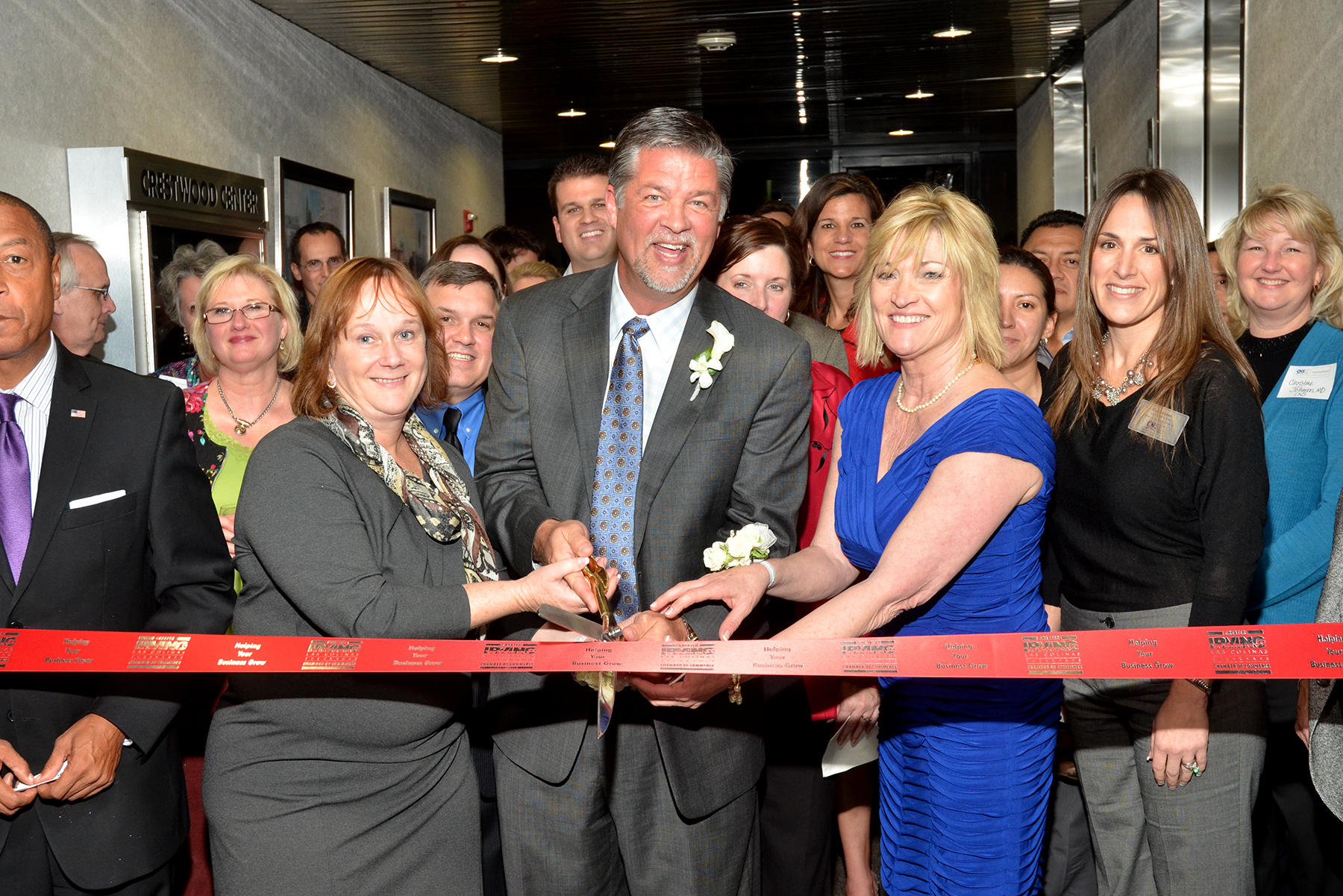
Today, Centre for Neuro Skills operates post-acute brain injury rehabilitation programs in seven locations across California and Texas, including Bakersfield, Los Angeles, San Francisco, Dallas, Fort Worth, Houston, and Austin. The organization employs about 1,000 people and serves hundreds of patients each year through highly structured treatment models that integrate therapy into daily living.
Susan Ashley said the work remains deeply meaningful.
“Seeing what someone couldn’t do at the beginning and what they can do later never gets old,” she said.
Investing back in SIU
The Ashleys’ success has translated into significant philanthropic impact at Southern, particularly through their support of faculty and research in Communication Disorders and Sciences.
They established the Dr. Mark and Susan Ashley Endowed Professorship of Audiology and the Dr. Mark and Susan Ashley Endowed Professorship of Speech Pathology, along with the Mark and Susan Ashley Professorship in Communication Disorders and Sciences Endowment Fund.
The professorship supports tenured or tenure-track faculty in the Communication Disorders and Sciences Program within the College of Health and Human Sciences.
Income from the endowment has been used to strengthen faculty recruitment and retention while advancing research, clinical training, and student support through graduate assistantships, professional travel, equipment upgrades, and other academic needs. Appointments are for five-year terms and may be renewed.
Since its establishment, the Mark and Susan Ashley Endowed Professorship has played a transformative role in the program. Endowment support has enabled major upgrades to the Communication Disorders and Sciences Lab and Student Resource Hub, funded research assistantships, and supported faculty participation in regional, national, and international conferences. Faculty research supported by the endowment spans areas such as augmentative and alternative communication in autism, simulation-based training for speech-language pathologists, and interprofessional collaboration in health sciences.
Dr. Valerie Boyer, a recipient of the Ashley Endowed Professorship, said the support has had a direct and lasting impact on both faculty and students.
“This endowment has allowed us to pursue research and professional development opportunities that simply would not have been possible otherwise,” Boyer said. “It strengthens our ability to train future clinicians while contributing meaningful scholarship to the field.”
Dr. Maria Claudia Franca, also an endowed professor, said the investment has elevated the program’s national and international engagement.
“The Ashley Endowed Professorship has expanded our capacity to collaborate, present, and publish at the highest levels,” Franca said. “It has enhanced our teaching, advanced our research, and enriched the student experience in tangible ways.”
Dr. Mark Ashley said supporting faculty was a deliberate choice rooted in his own graduate school experience.
“Professors constantly face resource limitations,” he said. “When they want to take on a project, it can be frustrating and limiting for students. We wanted to help relieve some of that pressure.”
The Ashleys also support students through scholarships, remembering firsthand the strain of balancing coursework with multiple jobs.
“We made it,” Dr. Mark Ashley said. “But we had friends who didn’t have the same opportunities. If we can help a little, we should.”
A legacy of impact
Dr. Mark Ashley earned a bachelor’s degree from SUNY Geneseo in secondary education and speech pathology and audiology, followed by a master’s degree in speech pathology from SIU. He has received honorary degrees from both institutions. Susan Ashley also earned a master’s degree from SIU.
Their connection to SIU and Centre for Neuro Skills continues into the next generation. Their son, Dr. Matthew Ashley, and daughter-in-law, Dr. Jessica Ashley, both SIU Carbondale graduates who met as students, now serve in leadership roles at Centre for Neuro Skills. Dr. Matthew Ashley is the organization’s chief medical officer, and Dr. Jessica Ashley is a neuroscientist. Another son, Benjamin Ashley, serves as associate vice president of marketing and communications.
The Ashleys view their family’s involvement and their philanthropic support of SIU as part of the same commitment to advancing brain injury rehabilitation and investing in people.
“This is about continuing the work,” Dr. Mark Ashley said. “Helping people, supporting those who teach, and making sure the next generation has the resources to push the field forward.”
From graduate students in Carbondale to leaders in brain injury rehabilitation, the Ashleys’ story reflects the lasting impact of an SIU education and the power of giving back to the institution that helped make it possible.
An institution defined by access and excellence
Southern Illinois University Carbondale is one of only 21 universities nationwide to hold both Carnegie Research 1 (R1) and Opportunity University designations, reflecting its strength in high-level research and its commitment to expanding access and outcomes for students from all backgrounds. As SIU continues to advance as a national research institution focused on student success, the Ashleys’ investment helps ensure the university remains a place where education, access, and impact move forward together.