Category Archives: Donor Stories

Giesen family names Achieve Student Hub, establishes scholarship for SIU students

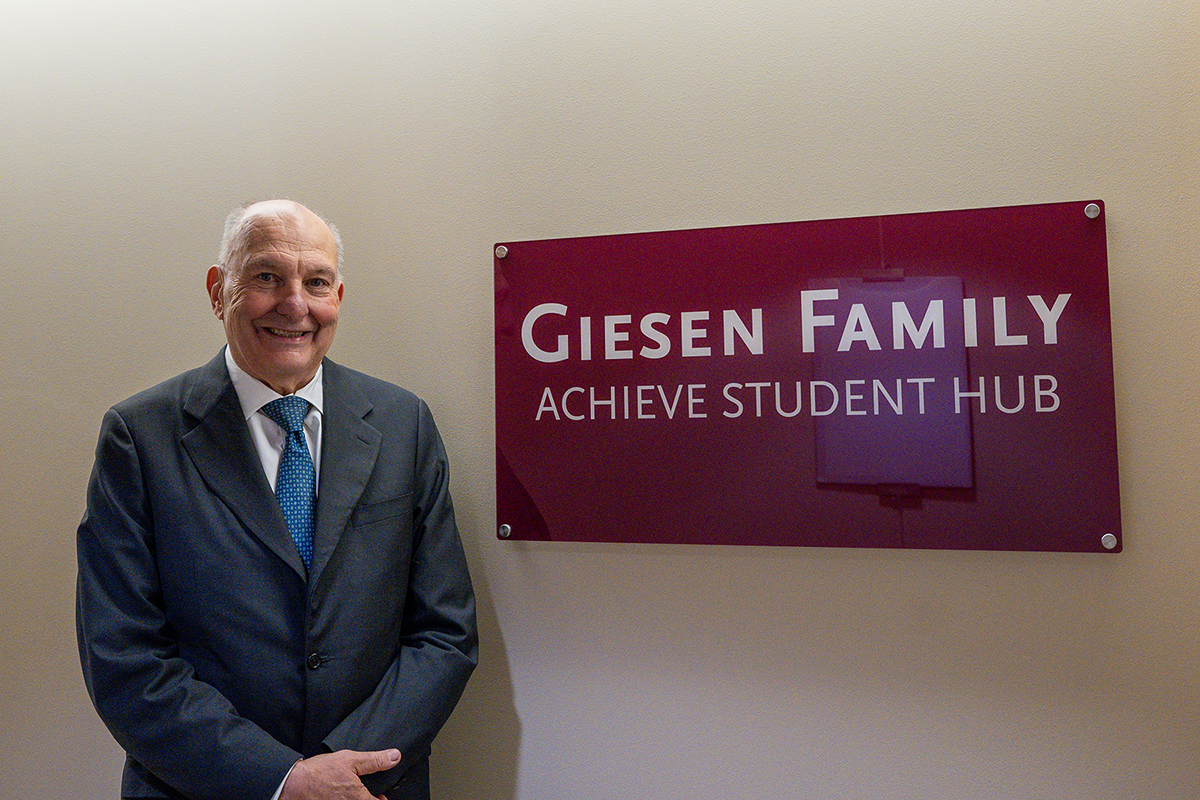
Dave Giesen stands beside the newly unveiled Giesen Family Achieve Student Hub sign at Southern Illinois University.
Dave Giesen stands beside the Giesen Family Achieve Student Hub signage following the Aug. 13 naming celebration. Giesen and his wife, Lauri, established an endowed scholarship to support students in the Achieve Program, which helped their children, Tracy and Alex, during their time at SIU.

Southern Illinois University’s Achieve Program celebrated the naming of the Giesen Family Achieve Student Hub on Aug. 13, honoring a family whose experience with the program inspired a commitment to helping future Salukis succeed.

Dave and Lauri Giesen established an endowed scholarship to support students in Achieve, a comprehensive academic support program for SIU students with learning differences. Their children, Tracy and Alex, participated in Achieve and graduated from SIU.

Dave Giesen joined Achieve students, families, staff and university representatives for the celebration, which included a ribbon-cutting and the unveiling of the newly named student hub.

The Giesens’ support grew from their children’s experiences with the program.

“When we evaluated universities for our children, Achieve turned out to be the perfect fit for both of them,” Giesen said. “They both earned their degrees from SIU and were immensely proud of what they accomplished and the role the program played in their success.”

The Giesens first learned about Achieve while exploring colleges that could provide their daughter with academic support. After visiting SIU and meeting with Achieve staff, Tracy chose SIU over two other universities. Her experience later influenced Alex to follow her to Carbondale.

Giesen said SIU also offered his children the flexibility of a comprehensive university, allowing them to explore different academic paths while receiving individualized support through Achieve.

Part of SIU’s Office for Access and Accommodations, Achieve has supported students with learning differences for nearly 50 years, making it one of the country’s most established programs of its kind.

The comprehensive, fee-for-service program provides managerial, organizational, structural, tutorial and social support for neurodiverse students, including those with learning disabilities, attention disorders, autism spectrum disorders and other learning differences or academic challenges.

Achieve supplements accommodations available through the Office for Access and Accommodations with individualized services designed to help students navigate college and stay on track toward graduation. More than 95% of Achieve students remain in good academic standing each semester, and one-third earn a place on the dean’s list. Students in the program typically remain on track to graduate within four to five years.

“Achieve is the best program in the country for what it does that nobody has ever heard of,” Giesen said. “It gives people who might not otherwise have the opportunity to attend college the support to develop their skills and ultimately contribute to society.”

Roger Pugh, director of the Achieve Program, said the family has maintained its connection to Achieve since Tracy and Alex completed the program.

“We’ve known the Giesen family for a long time,” Pugh said. “Tracy and Alex both came through the program and have gone on to build successful lives. We’ve stayed in touch with them over the years, and it has been a blessing to see what they’ve accomplished.”

The Giesens began supporting Achieve years before establishing the endowed scholarship. When a student needed financial assistance to participate in the program, they joined other Achieve families in helping cover the cost. That experience inspired their continued giving.

Giesen credits his parents with instilling the philosophy that guides his family’s philanthropy.

“The lesson they taught us when we were young was to pay it forward,” he said. “We’ve been fortunate throughout our lives, and they taught us to make sure others could benefit from that good fortune.”

The endowed scholarship will help students and families manage the costs of participating in Achieve. The program awarded the scholarship to its first two recipients during the naming celebration.

“Every year, we have students and families considering our program and wondering how they’re going to manage all the costs associated with college,” Pugh said. “This scholarship will help make that decision easier for them.”

Pugh said generosity from former students and Achieve families has helped the program support students for years.

“Dave, Lauri, Alex and Tracy, your gift is going to help students for many years to come,” Pugh said.

The celebration coincided with Achieve’s orientation for new and returning students and their families. Students met staff members, explored the program’s space and connected with the case managers who will support them throughout the academic year.

The Giesen Family Achieve Student Hub will serve as a central gathering place for students and a lasting reminder of the family’s commitment to the program.

Giesen encouraged scholarship recipients to carry that spirit of generosity forward.

“Work hard and do the best you can,” he said. “If you have the ability in the years to come, look back at your experience here and help the people following behind you.”

The Giesen family’s gift adds to the momentum of the Imagine SIU 2030 fundraising campaign, which has reached $485 million in commitments toward its $500 million goal. With two years remaining, the campaign has achieved 97% of its goal and remains one of the largest fundraising efforts in Illinois public university history.

Scholarship support remains a key part of that philanthropic impact. During the most recent fiscal year, the SIU Foundation awarded a record $6.9 million in scholarships to more than 2,200 students, benefiting nearly 19% of the student body.

Simmons Law School unveils Wall of Philanthropy honoring donors, charter class

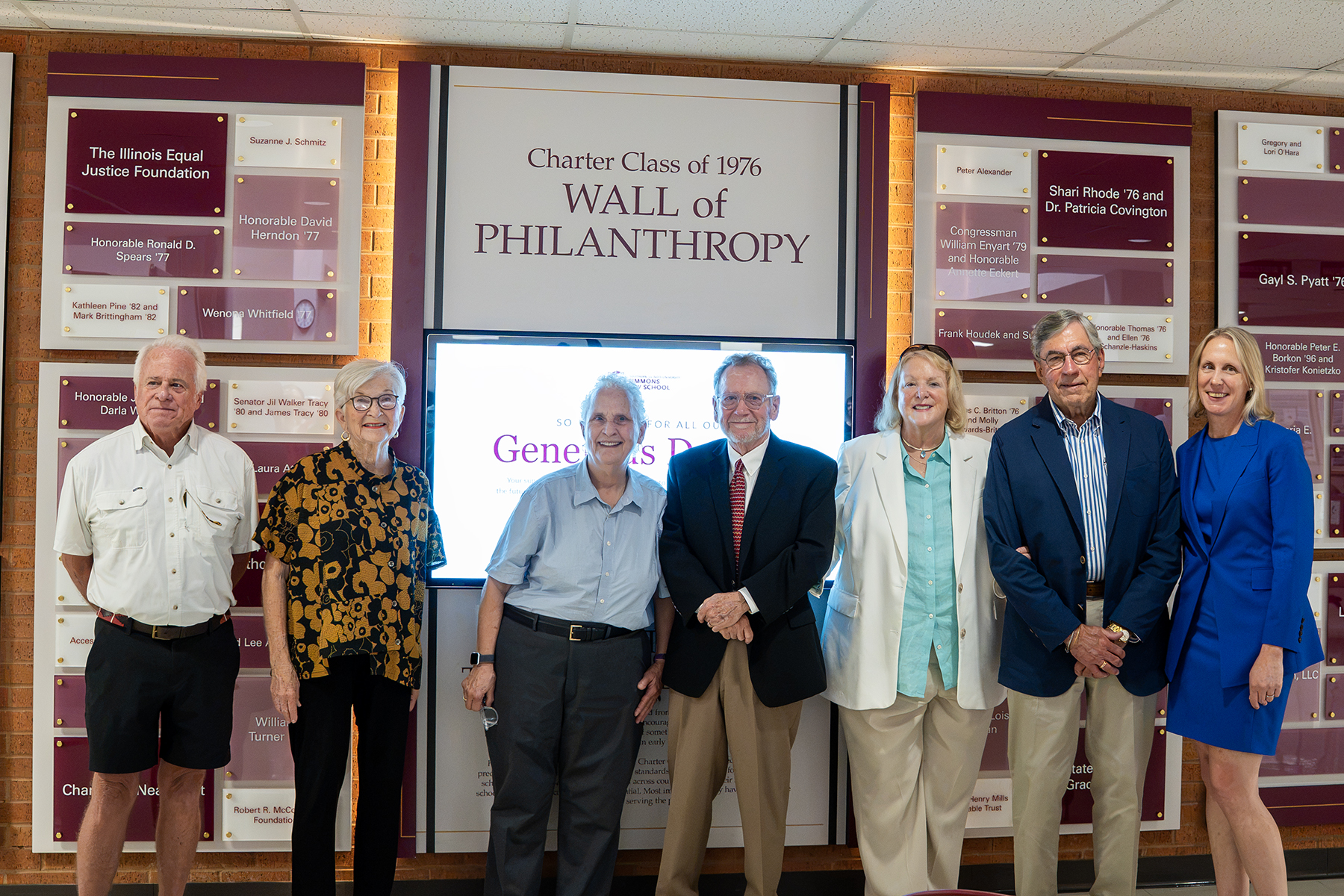
Donors and members of the SIU Simmons Law School charter class stand in front of the newly unveiled Wall of Philanthropy.

By Britni Bateman

The Southern Illinois University Simmons Law School celebrated the generosity behind its first five decades and honored the pioneering students who helped build its foundation during the unveiling of the new Wall of Philanthropy on Friday, Aug. 14.

The wall recognizes donors who have advanced legal education at SIU and pays special tribute to members of the law school’s charter class, who began their legal education in 1973. Members of the class helped spearhead funding for the project and participated in the unveiling.

The law school unveiled the wall after its induction ceremony for the incoming Class of 2029, connecting the students who helped establish the school with the newest generation beginning their legal education.

Dean Hannah Brenner Johnson

Dean Hannah Brenner Johnson said the timing provided an opportunity to celebrate both the law school’s history and its future.

“Every tile on the wall tells a story, whether it represents a gift from an individual, a couple, a family or an entity,” Brenner Johnson said. “It supports a belief in the power of legal education and the importance of supporting the future of the legal profession.”

The Wall of Philanthropy combines permanent donor recognition with an interactive digital display where students, alumni and visitors can learn about the people and philanthropy behind Simmons Law School. The display features donor stories and key moments from the school’s history.

A historical timeline traces major SIU Law events, including the school’s creation, charter class milestones and more than five decades of growth. The timeline draws from Celebrating the First Fifty Years of Southern Illinois University Simmons Law School by Frank G. Houdek, professor emeritus, published by SIU Press in 2023.

As a public law school, Simmons Law School strives to provide an excellent and affordable legal education. Philanthropy expands opportunities for students and faculty and helps advance that mission.

Donors fund scholarships, help attract faculty with specialized expertise, provide opportunities for students to attend national conferences, support faculty research and strengthen the legal clinic. Through the clinic, students gain practical experience while helping meet legal needs throughout the region.

“Our law school was created to serve the public good, to address unmet legal needs in Southern Illinois and our region by training lawyers,” Brenner Johnson said.

Since its charter class graduated in 1976, Simmons Law School has grown to more than 4,600 graduates. Alumni include more than 200 local, state and federal judges, and graduates practice law in all 50 states and 10 countries.

Charter class helped build foundation for law school

Charter class member Gayl Pyatt, a retired attorney, public servant and longtime SIU supporter, reflected on the law school’s beginnings before joining fellow classmates to unveil the wall.

SIU hired Hiram Lesar in 1972 as founding dean to lead the development of the new law school. The following year, Pyatt joined 79 other students in its charter class. Fifteen of the 80 students were women.

The charter class began its legal education in September 1973 in temporary quarters known as the “Blue Barracks.” After their first semester, students moved to two small group housing buildings across the street from the site of the current law school.

Gayl Pyatt
Gayl Pyatt

“We never had the joy of having a class in a building like this,” Pyatt said as she reflected on the facilities available to today’s students.

The charter class also had no upperclassmen to turn to for advice about professors, classes or exams. Instead, the students relied on one another as they navigated the new program.

“We were all on our own,” Pyatt said. “What did that mean? It meant we worked together. We were a team getting through this first year.”

Lesar came to SIU after serving 12 years as dean of the Washington University School of Law. At SIU, he recruited faculty, developed the curriculum, secured classroom space and led efforts to build the law school’s permanent home.

Pyatt recalled a classmate asking Lesar why he should choose the new SIU law school when other institutions offered him scholarships.

Lesar’s answer captured the significance of the opportunity: “There is only one first class.”

That first class continued helping shape the school throughout its three years together. In May 1976, the law school published the inaugural issue of the Southern Illinois University Law Journal, with Pyatt, then Gayl Alexander, serving as editor-in-chief. Later that month, members of the charter class received their law degrees at the school’s first commencement ceremony.

More than 50 years after arriving at SIU, members of the charter class remain engaged with the institution they helped build.

Philanthropy carries legacy forward

Kate Hanson, senior director of development for the Simmons Law School, began working closely with members of the charter class as the law school celebrated its 50th anniversary. She said getting to know them gave her a greater understanding of their role in the school’s history.

Kate Hanson
Kate Hanson

“They joined a brand-new law school and helped build the foundation upon which the school stands today,” Hanson said. “We want to make them proud and ensure their legacy is remembered.”

When Hanson approached Pyatt about creating a donor wall, Pyatt suggested honoring her classmates through the project. The charter class then helped bring that vision to life.

“The members of the charter class are among the law school’s most philanthropic and generous supporters, but their impact cannot be measured solely by the gifts they have made,” Hanson said. “They remain involved. They care deeply about this institution, its students and its future.”

The Wall of Philanthropy honors that legacy alongside generations of donors whose generosity continues to move Simmons Law School forward.

“My hope is that every student, alum, faculty member and visitor who sees this wall will be inspired by the charter class and by the generosity of those who have supported the law school’s journey,” Hanson said.

To support the SIU Simmons Law School and help provide opportunities for future generations of students, visit siuf.org/law.

Moneta continues support as Premier Sponsor of 5th Annual Saluki Women’s Weekend

Moneta logo

Moneta is continuing its support as a Premier Sponsor of the 5th Annual Saluki Women’s Weekend, set for Sept. 10-12 at Southern Illinois University Carbondale. Moneta has supported the event every year since its launch in 2022.

Diane Compardo headshotFor Diane Compardo, a Moneta partner and two-time SIU graduate who earned her master’s from the College of Business and Analytics in 1992, the partnership provides an opportunity to give back to the university that helped shape her future while creating similar opportunities for the next generation.

“I came to SIU as a young woman from a small town, and I didn’t know what my career would look like or where it would take me,” Compardo said. “SIU opened so many opportunities for me.”

Compardo has been involved with Saluki Women’s Weekend since its launch and has watched it grow over the past five years.

“The evolution of Saluki Women’s Weekend has been wonderful,” she said. “We started reasonably small, and every year it gets bigger with more energy in the room.”

Paying it forward

Hosted by the SIU Foundation Women’s Leadership Council and presented by Moneta and SIU Credit Union, Saluki Women’s Weekend creates opportunities for women to connect across generations and stages of their careers.

Compardo has spent more than 25 years at Moneta, a financial advisory firm based in St. Louis. She said Moneta encourages its partners to support organizations and causes that are personally meaningful to them.

“Moneta is a very philanthropic organization, and one of my passions is supporting women,” Compardo said. “That’s why I choose Saluki Women’s Weekend as one of the events I support.”

For Compardo, that support reflects her belief in paying forward the encouragement and opportunities she received throughout her education and career.

“I was fortunate to have people who invested in me, encouraged me and opened doors for me,” she said. “I think we have a responsibility to do the same for the next generation.”

That connection extends beyond Saluki Women’s Weekend. Compardo has returned to SIU to speak with students at the College of Business and Analytics about Moneta and career opportunities. Several SIU alumni work at the firm, and a recent SIU graduate is joining Compardo’s team.

Celebrating at the Tedrick Welcome Center

This year’s Women’s Empowerment Conference will take place Sept. 11 at the Tedrick Welcome Center, adding another personal connection for Compardo.

Compardo is past president of the SIU Foundation Board of Directors and served as president during much of the planning and approval process for the new facility.

“It’s a wonderful space to welcome students and host events that showcase the best of SIU,” she said.

The weekend begins Sept. 10 with the Women’s Leadership Council Welcome Reception at Hangar 9 in downtown Carbondale. The evening will feature line dancing instruction from Kyle Erickson, better known as Cowboy Kyle, founder of Urban Cowboy Line Dancing in Nashville, Tennessee.

The Women’s Empowerment Conference follows Sept. 11 at the Tedrick Welcome Center with educational sessions, networking opportunities and the Philanthropy and Woman of the Year Awards Luncheon. This year’s programming also recognizes the United Nations’ International Year of the Woman Farmer.

Activities conclude Sept. 12 with a Women’s Leadership Council board meeting for invited members and a mentorship brunch connecting students, alumni and professionals.

As Saluki Women’s Weekend celebrates its fifth anniversary, Compardo encourages students and alumni to take advantage of the relationships the event can create.

“Say yes to opportunities. Say yes to meeting people. Say yes to experiences that may be outside your comfort zone,” she said. “Embrace the experience and run with it.”

Compardo hopes those connections continue to grow along with the event.

“The SIU connection is so powerful,” she said. “It feels like you’re coming home to a room full of family.”

Registration for the 5th Annual Saluki Women’s Weekend is free. Learn more and register at siuf.org/saluki-women.

Jim Hayes Stadium Club dedicated at Saluki Stadium

Jamie and Netta Hayes cut the ribbon during the dedication of the Jim Hayes Stadium Club at Saluki Stadium on Thursday, Aug. 13. The newly renovated space, named in honor of Jamie Hayes' father and longtime Saluki supporter Jim Hayes, was made possible through the couple's $1 million gift to Saluki Athletics.
Jamie and Netta Hayes cut the ribbon during the dedication of the Jim Hayes Stadium Club at Saluki Stadium on Thursday, Aug. 13. The newly renovated space, named in honor of Jamie Hayes’ father and longtime Saluki supporter Jim Hayes, was made possible through the couple’s $1 million gift to Saluki Athletics.

By Britni Bateman

Southern Illinois University Carbondale celebrated the legacy of longtime Saluki supporter Jim Hayes on Thursday, Aug. 13, with the dedication and ribbon cutting of the newly renovated Jim Hayes Stadium Club at Saluki Stadium.

Family and friends gathered for the private event, which recognized a $1 million gift from Jamie and Netta Hayes to Saluki Athletics. The gift honors Jamie Hayes’ father, Jim Hayes, who came to SIU on a football scholarship in 1961 and remained a devoted supporter of the university throughout his life.

The gift helped revitalize the stadium club, one of Saluki Stadium’s premier gathering spaces. The renovation includes new premium chairback seating along the east side, new flooring and branded walls, an SIU Dawg Head ceiling, enhanced lighting, two permanent bars, a TV wall and new furniture. The space will serve Saluki fans on game days and provide a venue for university events, major announcements and football recruiting.

For Jamie Hayes, the dedication was an opportunity to honor the man who first introduced him to SIU.

“I wanted to do something special for my dad,” Hayes said. “I think it’s every kid’s dream to be able to honor his father in some way. I’m proud to be part of the SIU team.”

Jim Hayes played linebacker for the Salukis and earned the nickname “The Axe.” After graduating from SIU with a degree in education in 1962, he taught and coached football in Macomb before entering the automotive industry. He moved his family to Harrisburg in 1976 and founded Jim Hayes Inc., a car dealership now owned and operated by his son.

Jamie Hayes grew up attending Saluki basketball and football games with his father. He graduated from SIU in 1994 with a degree in speech communication and has continued his family’s tradition of supporting Saluki Athletics through charitable giving and partnerships through his business.

“He had a lot of great loves,” Hayes said of his father. “He loved his family, his business, his employees, his customers and SIU.”

Jim Hayes died in 2018, but his connection to SIU continues through his family and now through the stadium club that bears his name.

Saluki football coach Nick Hill got to know Jim Hayes during the final years of his life and remembered him as a consummate professional and loyal supporter of the program.

“He was a first-class individual,” Hill said. “I’m excited that his name will be here forever. I think Jim would be proud.”

Hill also praised the stadium club and the opportunities it will create for the football program.

“It’s a first-class facility,” he said. “It’s a great space that fans will be excited about. We’ll use it in recruiting, and I know Saluki fans will enjoy it for a long time.”

SIU Director of Intercollegiate Athletics Tim Leonard credited Jamie and Netta Hayes with believing in the future of Saluki Athletics and helping inspire others to invest in the program.

“We don’t measure ourselves by what we lack. We measure ourselves by what we build together,” Leonard said. “That’s what Jamie and Netta believe.”

Leonard said the Hayes family wanted its support to make an impact on the football program, the university and Southern Illinois.

“Jamie said, ‘I want to do something for our region. I want to do something for our university. But most importantly, I want to do something for this football program because it meant so much to my dad,'” Leonard said.

For Hayes, supporting SIU goes beyond athletics. As a Southern Illinois business owner, he views a strong university as an important part of the region’s future.

“When you’re from this region and you’re a business owner, you should cultivate a relationship with the university because the success of SIU, academically and athletically, can only help the region,” Hayes said.

He encouraged other alumni, businesses and community members to get involved as SIU continues building momentum.

“I think people in Southern Illinois sometimes take SIU for granted,” Hayes said. “Our campus and everything we have going on here rival any college in America. I think SIU is on the cusp of taking that next step.”

For Hayes, the evening came back to family and the Saluki tradition his father passed down to him.

“He brought me into the fold when it came to SIU, and this is a way of adding to his legacy,” Hayes said. “You have to bleed maroon no matter what.”

The Hayes family’s support is part of the Imagine SIU 2030 fundraising campaign, which has raised more than $485 million toward its $500 million goal with approximately two years remaining. The campaign is the fifth-largest fundraising effort in Illinois higher education and supports scholarships, academic programs, research, facilities and student success across SIU.

The dedication comes on the heels of a record year of support for Saluki Athletics. In fiscal year 2026, the department generated nearly $10.4 million in gifts and commitments, marking the most successful fundraising year in its history and setting multiple records as support for Saluki Athletics continues to grow.

Fans interested in access to the Jim Hayes Stadium Club can submit an interest form for more information.

To make a gift to Saluki Athletics, visit saluk.is/give. For more information about making a gift of any size or exploring naming opportunities, contact Kat Martin at katm@foundation.siu.edu or 815-757-0308.

SIU Credit Union celebrates five years of supporting Saluki Women’s Weekend

SIU Credit Union logo

SIU Credit Union is continuing its support of Saluki women as a Premier Sponsor of the 5th Annual Saluki Women’s Weekend, set for Sept. 10-12 at Southern Illinois University Carbondale.

The credit union has supported the event since its launch in 2022, helping create opportunities for women to connect through leadership, mentorship and philanthropy.

For Melissa Kinnard, community outreach specialist at SIU Credit Union and an SIU alumna, the partnership reflects the credit union’s longstanding commitment to supporting the university and Southern Illinois.

“Our philosophy is people helping people,” Kinnard said. “And with this event, we have women helping women, to support, encourage, mentor and inspire one another.”

Hosted by the SIU Foundation Women’s Leadership Council and presented by Moneta and SIU Credit Union, Saluki Women’s Weekend brings together alumni, students, faculty, staff and community members for three days of networking, professional development, philanthropy and mentorship.

“It’s been an honor and a privilege to have been a part of this since the very beginning,” Kinnard said. “We are proud to get a chance to help celebrate and acknowledge the incredible accomplishments of these amazing women, as well as help shine a spotlight on the importance of mentorship and philanthropy.”

The partnership also reflects the people behind SIU Credit Union. Kinnard said much of its staff and most of its leadership team are women, and many employees, including Kinnard, are SIU alumni.

“Once a Saluki, always a Saluki,” she said.

Supporting financial education and mentorship

As a member-owned, not-for-profit cooperative financial institution, SIU Credit Union emphasizes financial education and community engagement. Kinnard said helping people build financial literacy and work toward financial wellness is a key part of its mission.

That work is particularly important for women, she said. While women have made significant financial strides, disparities remain in areas such as retirement savings and access to funding for small businesses.

“We have a ways to go when it comes to making sure that every little girl grows up knowing financial literacy terms, but also how to manage her money and how to do personal finance,” Kinnard said.

SIU Credit Union provides financial education through online resources and outreach in schools, classrooms and community organizations. The credit union also sponsors financial literacy resources for area schools.

Kinnard sees a similar opportunity for growth through mentorship, another central focus of Saluki Women’s Weekend. She has experienced its impact through SIU students who have interned in the credit union’s marketing department.

“It has been amazing to get to teach as well as learn from them and also to see what incredible businesswomen they are becoming,” she said.

Celebrating five years

The 5th Annual Saluki Women’s Weekend begins Sept. 10 with the Women’s Leadership Council Welcome Reception at Hangar 9 in downtown Carbondale. The evening will feature line dancing instruction from Kyle Erickson, better known as Cowboy Kyle, founder of Urban Cowboy Line Dancing in Nashville, Tennessee.

The Women’s Empowerment Conference follows Sept. 11 at the Tedrick Welcome Center with educational sessions, networking opportunities and the Philanthropy and Woman of the Year Awards Luncheon. This year’s programming also recognizes the United Nations’ International Year of the Woman Farmer.

Activities conclude Sept. 12 with a Women’s Leadership Council board meeting for invited members and a mentorship brunch connecting students, alumni and professionals.

For SIU Credit Union, the fifth anniversary provides another opportunity to invest in the university and the women who make an impact across the Saluki community.

“We really love and support this incredible event,” Kinnard said. “To get a chance to sponsor it every year and to now celebrate the fifth anniversary, what an incredible accomplishment.”

Registration for the 5th Annual Saluki Women’s Weekend is free. Learn more and register at siuf.org/saluki-women.

SIU celebrates historic grand opening of Tedrick Welcome Center, welcoming more than 1,000 guests

Southern Illinois University Carbondale and the SIU Foundation drew a crowd of more than 1,000 students, faculty, staff, alumni and community members Friday, May 1, to celebrate the grand opening of the Tedrick Welcome Center, marking a major milestone and a new front porch to the university at its main entrance.

The 44,000-square-foot facility will serve as the new home of the SIU Foundation and a central hub for campus visits, events and engagement. Hundreds more visitors attended a public open house Saturday, May 2, touring the building and exploring its interactive features.

“This is the building we want students to walk into first,” said Chancellor Austin A. Lane. “This is where they begin to understand what it means to be a Saluki. They will see the greatness happening at SIU and quickly realize how special this place is.”

Lane emphasized the distinct role the Tedrick Welcome Center will play in the campus experience, complementing other key facilities.

“This is where we welcome students,” he said. “Once we wow them here, we serve them across the street at the Student Services Building, and we engage them in the Student Center. Each space has a purpose, and this building is what will attract and capture future Salukis.”

The dedication ceremony, held inside the building’s flex space, featured remarks from university and foundation leadership.

“This is a great day for Southern Illinois University,” said Dr. Dan Mahony, president of the SIU System. “We could have built a building just for the SIU Foundation, but we chose to think bigger. This welcome center is a difference maker for the entire university, and it would not be possible without the vision of the SIU Foundation Board and the support of the Board of Trustees.”

Serving as emcee, Matt Kupec, vice chancellor for development and alumni relations and CEO of the SIU Foundation, highlighted the building’s features and its role in shaping first impressions.

“This is 44,000 square feet dedicated to telling the Saluki story,” Kupec said. “With 11 interactive displays, personalized welcome experiences and spaces designed to engage visitors, this is a place where students can immediately see themselves at SIU. It is, without question, the best welcome center in the state of Illinois.”

Kupec also emphasized the project’s funding model.

“Not one dollar of state appropriations or student fees was used to build this facility,” he said. “This was made possible by our donors, the SIU Foundation and a commitment to invest in the future of this university.”

A highlight of the program included remarks from lead donors Roger and Sally Tedrick, whose $6 million gift helped launch the project.

“The decision to make this gift was simple. It was the right thing to do,” Roger Tedrick said. “This university gave our families the opportunity to succeed. We believe in what is happening at SIU, and we wanted to do something that would help attract future students and support this institution for generations to come.”

Tedrick reflected on both his and Sally’s deep-rooted connections to the university and the role it played in shaping their families’ futures.

“My parents moved our family to Carbondale so we could have access to an education they could not otherwise afford,” he said. “This campus was our backyard. It shaped who we are, and giving back is a way to honor that legacy.”

He said Sally’s family shared a similar story. Her parents moved to Carbondale in the 1950s, and her father worked as a contractor who helped build student housing near campus. Her mother earned both a bachelor’s and master’s degree from SIU, and all five daughters in the family attended the university.

“This institution gave both of our families a start,” Tedrick said. “When you have that kind of impact on your life, giving back is something you feel called to do.”

Judge Phil Gilbert, chair of the SIU Board of Trustees, spoke to the Tedricks’ deep ties to the university and their lasting impact.

“This gift was never about recognition,” Gilbert said. “It was about the past, present and future of this university. This building now stands as the front porch of SIU, welcoming students, alumni and visitors and representing everything this institution has become.”

Dan Korte, president of the SIU Foundation Board of Directors, reflected on the project’s origins and its long-term impact.

“This changes everything,” Korte said. “What will happen in this building in the years ahead will inspire future students and donors. It gives us a place to showcase the Saluki spirit and the life-changing impact of this university.”

Korte said the project grew from a need to relocate the SIU Foundation and evolved into a broader vision for campus.

“We didn’t just want to build office space,” he said. “We wanted to create a front porch for this university, a place that welcomes people and tells our story. This building represents transformation and shows what is possible when people come together around a shared vision.”

Greg Cook, emeritus board member of the SIU Foundation Board of Directors, said the idea for the project had been years in the making.

“We knew the Foundation needed a new home, but we also knew this had to be something more,” Cook said. “This location and this concept give the university a prominent, welcoming front porch that benefits everyone who comes to campus.”

Following the program, the Marching Salukis performed as the crowd gathered for the ceremonial ribbon-cutting. Surrounded by university leaders and dignitaries, Roger and Sally Tedrick cut the ribbon, officially opening the facility. The SIU Foundation also presented the Tedricks with a 3D model of the building in recognition of their leadership and generosity.

The Tedrick Welcome Center stands on the former site of McAndrew Stadium and was completed in approximately 20 months, ahead of schedule and under budget. The facility anchors campus tours, orientations, alumni engagement and major events while housing SIU Foundation operations.

“This is a building you would expect to see in a major city,” Kupec said. “And it is right here in Carbondale, serving as a bold statement about the future of Southern Illinois University.”

SIU is one of only 21 universities nationwide to hold dual Carnegie Classification designations as a Research 1 institution and an Opportunity University, placing it among an elite group recognized for both high research activity and student access.

The Tedrick Welcome Center also reflects the momentum behind the Imagine SIU 2030 fundraising campaign. To date, the campaign has raised more than $467 million toward its $500 million goal, supporting scholarships, facilities and initiatives that enhance the student experience.

For more information about the Tedrick Welcome Center, visit siuf.org/twc.

England Student Center Lounge dedicated at SIU, honoring student vision and donor generosity

Bob and Pat England cut the ribbon for the England Student Center Lounge.

More than 100 students, faculty and staff packed the fourth floor of the Southern Illinois University Student Center to celebrate the dedication of the England Student Center Lounge, a student-driven project made possible by a $250,000 gift from alumni Bob and Pat England. 

The renovated space, formerly home to the WIDB radio station, now serves as a modern, multipurpose lounge designed to meet student needs, particularly for commuters seeking a place to gather, collaborate and recharge between classes. 

“This is much more than just opening a room,” said Lydia Phelps, president of the Undergraduate Student Government. “It is the realization of an idea that started with students simply asking for a place to belong.” 

The project originated with Undergraduate Student Government leaders, who envisioned a “third space” on campus, neither a classroom nor a residence hall, where students could build community. Through surveys, forums and ongoing input, the concept evolved into a lounge featuring collaboration areas, a podcast and music recording space, conference rooms, workout equipment, a kitchenette and areas for rest and reflection. 

Phelps credited former USG President Penny Bordewick with launching the initiative. 

“Penny saw potential in an empty fourth-floor space and imagined something far greater,” Phelps said. “Her leadership laid the foundation for everything we are celebrating today.” 

Bordewick said the idea began during a walkthrough of the underutilized space in 2024. 

“It was kind of a mess,” she said. “But the vision for what it could become was so clear. We knew this could be a place built by students, for students.” 

The project gained momentum through continued advocacy by student leaders and collaboration with Student Affairs, the Student Center and the SIU Foundation. 

Brian Flath, director of development for student affairs with the SIU Foundation, said the project aligned closely with student needs. 

“We love a great vision, and we love serving students’ needs,” Flath said. “To take a dream that students had and see it come to fruition is really magic.” 

Flath said the Englands committed to the project shortly after learning about the proposal, allowing the renovation to move forward. 

Vice Chancellor for Student Affairs Dr. Jeffery Burgin emphasized the importance of student leadership. 

“When the students said they wanted it, you have to give them what they need,” Burgin said. “This space is a testament to what happens when student voices are heard and supported.” 

He also noted the collaborative nature of the project, including contributions from interior design students who helped shape the space. 

Bob and Pat England said their gift was inspired by their own experiences at SIU and their belief in supporting future students. 

“SIU has changed our lives, and for that we are deeply grateful,” Bob England said. “This gift is a way for us to say thank you.” 

Pat England said they hope the lounge becomes a hub for creativity and connection. 

“Students are our future,” she said. “We hope this will be a place where ideas come together and grow into something meaningful.” 

The Englands encouraged students to take full advantage of their time at SIU. 

“Be curious, work hard, support each other and take risks,” Bob England said. “Someday you will look back and recognize how these years have shaped you.” 

“Today, we’re not just cutting a ribbon,” Phelps said. “We’re opening a space that reflects the heart of SIU: collaboration, opportunity, creativity and community.” 

For the Englands, the gift honors the university that shaped their lives and the connections they formed on campus. 

“We’re incredibly grateful for what Bob received through his education at SIU,” Pat England said. “And what I got from SIU was Bob.” 

Their gift also supports the Imagine SIU 2030 fundraising campaign, which has approximately 2 1/2 years remaining. To date, the campaign has raised more than $464 million toward its $500 million goal, making it the fifth-largest fundraising effort in Illinois higher education. 

Southern Illinois University Carbondale is one of only 21 universities nationwide to hold both Carnegie Research 1 and Opportunity University designations, reflecting its strength in high-level research and its commitment to expanding access and outcomes for students from all backgrounds. 

As SIU advances as a national research institution focused on student success, investments like the Englands’ help strengthen the campus environment where students live, learn and grow. 

In the most recent fiscal year, the SIU Foundation awarded more than $5.6 million in scholarships to 2,111 students, representing 17% of the student body. 

For the Englands, the impact of their gift comes down to something simple: helping ensure future students find the same sense of opportunity, belonging and possibility that defined their own time at SIU. 

From Saluki Sweethearts to Successful Entrepreneurs

Bob and Pat England give back to the place where their story began

Bob and Pat England portrait

By Britni Bateman

More than 50 years after meeting at Southern Illinois University Carbondale, Bob and Pat England are giving back to the place where their story began.

Through a $250,000 gift, the couple has established the England Student Center Lounge, a gathering space for students on the fourth floor of the SIU Student Center. Their gift will support maintenance and ongoing enhancements, ensuring the space serves generations of Salukis.

For the Englands, the gift honors the university that shaped their lives and celebrates the connections they formed on campus.

“We’re incredibly grateful for what Bob received through his education at SIU,” Pat England said. “And what I got from SIU was Bob.”

A ribbon-cutting ceremony dedicating the England Student Center Lounge will take place from 11 a.m. to 1 p.m. Thursday, April 30, 2026, in the SIU Student Center. Remarks are scheduled for 11:15 a.m.

A Saluki education that opened doors

Bob England arrived at SIU from Decatur, Illinois, on a football scholarship in the late 1960s. Like many first-generation college students, the transition to college life wasn’t easy at first.

He struggled academically before realizing that success at SIU required a new level of commitment.

“I figured out pretty quickly that I needed to focus,” Bob said. “Once I did, everything changed.”

Bob found his place in the university’s industrial technology program, which provided hands-on training in fields ranging from engineering and mathematics to foundry work and construction methods.

“It gave me exposure to a little bit of everything,” he said. “I understood enough about a lot of subjects that I could talk with anyone about what they were doing.”

That versatility became a defining strength throughout his career.

After graduating in 1969, Bob began working in the steel industry before eventually becoming an entrepreneur.

Pat and Bob England are standing together at the front of a church on their wedding day, wearing formal wedding attire, with floral arrangements, candles, and a cross visible in the background.A phone call that changed everything

While Bob’s academic path shaped his career, a simple phone call shaped his life.

In 1969, Bob called a friend living in Steagall Hall on campus, hoping to find a date for a party that weekend. As fate would have it, Pat, who is originally from Carmi, Illinois, happened to be walking down the hallway when the friend answered the phone and handed her the receiver.

The conversation led to their first meeting, which included a drive through Carbondale during a rainstorm in Bob’s red 1967 Mustang and a stop for coffee.

The connection was immediate.

“Before long we were inseparable,” Pat said.

The couple married just months later and have now been together for 57 years.

N-Line Traffic Maintenance logo - Black sign with reflective red-and-white diagonal stripes forming a large letter “N,” the words “N-Line” and “Traffic Maintenance,” and a stylized roadway graphic along the bottom.Building a family business

After starting their careers, Bob and Pat eventually moved to Texas, where they built a business with their two sons.

What began as a small operation grew into N-Line Traffic Maintenance, a company specializing in roadway striping and traffic safety.

The company expanded rapidly and eventually employed more than 500 people across Texas before the family sold the business after 24 years.

Throughout its growth, the Englands focused on work that mattered.

“Paint on a road might not seem like much,” Pat said. “But those lines keep people in their lanes and keep them safe.”

The company created jobs and helped protect workers and drivers on highways and construction sites.

“It was about providing opportunities for people,” Bob said.

Memories that never faded

Although the Englands eventually settled in Jupiter, Florida, and rarely returned to campus, their memories of SIU never faded.

They remember walking through Thompson Woods between classes and spending time in the student center with friends.

One memory still makes them smile.

Students would gather in the student center lounge to watch the television show Dark Shadows, a daily ritual that brought people together.

“You don’t have to follow every game or come back every year to know how important a place was in your life,” Bob said. “We never forgot what SIU meant to us.”

Creating a place for connection

Curved modular lounge seating in the modern England Student Center Lounge, featuring gray upholstered sections with a red accent band and patterned fabric backs, arranged around three small round ottomans on a carpeted floor, with additional seating and tables visible in the background near large windows.

Their connection to campus resurfaced when they learned about an effort led by the Undergraduate Student Government to establish a dedicated student lounge in the SIU Student Center.

The idea began with Penny Bordewick, who campaigned for the creation of a student gathering space while serving as USG president. She believed students needed a welcoming place to study, collaborate and connect outside the classroom.

The initiative continued under Lydia Phelps, the next USG president, who carried forward the promise and helped move the project toward reality.

For Pat England, the vision behind the project felt especially meaningful. During her career in student life at Texas A&M University, she worked closely with students and saw firsthand how campus spaces and supportive leadership can help students pursue their ideas and ambitions. That experience deepened her appreciation for student-led initiatives like the effort at SIU.

When the Englands learned about the project, the idea resonated immediately.

The space itself reflects that student-driven vision. Located on the fourth floor of the Student Center, the lounge is transforming a once underutilized area, formerly home to student radio station WIDB, into a vibrant, multifunctional hub designed by students for students.

Plans for the space include flexible seating areas for conversation and collaboration, a large television for watch parties, recreational games and a jukebox, along with a feature wall honoring WIDB’s legacy. Bar-style seating overlooking Thompson Woods will provide a scenic place for students to gather, while upgraded sound and technology will support events and daily use.

Additional spaces will support a wide range of student needs, including study and small-group collaboration rooms with whiteboards and charging stations, a conference room for Registered Student Organization meetings, a podcast room inspired by WIDB’s history, and a kitchenette for convenience. The lounge will also include a dedicated lactation room, reinforcing the university’s commitment to supporting all students.

Together, these elements create a space that will be used daily by hundreds of students, from commuters to those living on campus, for studying, meetings and connecting between classes.

“We want students to have a place where they can meet, share ideas and relax,” Pat said. “College isn’t only about classes. It’s also about the relationships you build along the way.”

A legacy of opportunity

Looking back, the Englands say their story would not have unfolded the same way without SIU.

The university gave Bob the education that launched his career and gave both of them the place where their life together began.

“If this space helps students come together and make a difference, then we’re happy to be part of that,” Bob said.

And perhaps, they say with a smile, the England Student Center Lounge will even help spark a few new Saluki love stories.

Supporting connection and opportunity for future Salukis

Southern Illinois University Carbondale is one of only 21 universities nationwide to hold both Carnegie Research 1 (R1) and Opportunity University designations, reflecting its strength in high-level research and its commitment to expanding access and outcomes for students from all backgrounds.

As SIU advances as a national research institution focused on student success, investments like the Englands’ help strengthen the campus environment where students live, learn and grow.

Their gift also supports the Imagine SIU 2030 fundraising campaign, which has approximately 2½ years remaining. To date, the campaign has raised more than $464 million toward its $500 million goal, making it the fifth-largest fundraising effort in Illinois higher education.

In the most recent fiscal year, the SIU Foundation awarded more than $5.6 million in scholarships to 2,111 students, representing 17% of the student body.

For the Englands, the impact of their gift comes down to something simple: helping ensure that future students find the same sense of opportunity, belonging and possibility that defined their own time at SIU.

Dr. Mark and Susan Ashley: Building Centre for Neuro Skills and Giving Back to SIU

Dr. Mark Ashley and Susan Ashley stand together outside the historic Fox Theater beneath a marquee reading “Centre for Neuro Skills Celebrates 40 Yrs of Excellence,” marking the organization’s milestone anniversary.

By Britni Bateman

Dr. Mark and Susan Ashley came to Southern Illinois University as graduate students with a shared interest in speech pathology and left with an education that shaped both their careers and their commitment to giving back.

That commitment now extends far beyond Carbondale. The Ashleys are the founders of Centre for Neuro Skills, a nationally recognized provider of post-acute brain injury rehabilitation. Through their business success and philanthropy, they continue to strengthen SIU by supporting faculty excellence, student opportunity, and innovation in the field that launched their careers.

“We were happy with our experience at SIU,” Susan Ashley said. “I feel like I got a great education.”

From graduate students to innovators

Mark and Susan Ashley in the late 1980s.

The Ashleys met as children, dated in high school, and married after their first year of college. Both pursued undergraduate studies at the State University of New York at Geneseo before entering graduate programs to prepare for careers in speech pathology.

A visit to Carbondale proved pivotal.

Faculty members in SIU’s Communication Disorders and Sciences program welcomed them, introduced them to hands-on research, and demonstrated how interdisciplinary learning could expand their impact. Dr. Mark Ashley said the environment encouraged curiosity beyond a single discipline and supported collaboration across departments.

“That kind of thinking stays with you,” he said.

Graduate school was demanding. The Ashleys carried heavy course loads and worked multiple jobs to finish their master’s degrees in four semesters.

“We didn’t have a lot of money,” Dr. Mark Ashley said. “If we weren’t in school, we were working.”

Those years built both professional discipline and a lasting appreciation for the mentors who invested time and resources in them.

A business rooted in purpose

Dr. Mark Ashley’s professional path was shaped by personal experience. His brother suffered a severe brain injury while serving in the Navy, exposing him early to the long-term needs of individuals and families affected by neurologic injury.

While studying at SIU, Dr. Mark Ashley helped faculty members launch an experimental brain injury program in Carbondale. The work challenged prevailing assumptions in the field, particularly the belief that recovery plateaued after six months.

“The textbooks said that six months was it,” he said. “We’ve disproven that a multitude of times.”

After graduating in 1978, the Ashleys moved to California, where an unexpected career shift led Dr. Mark Ashley into private practice. Within a few years, he and his colleagues opened the first Centre for Neuro Skills facility in Bakersfield.

They started with a small building, modest staff, and personal loans. What they had, Dr. Mark Ashley said, was conviction.

“I didn’t believe we would fail,” he said. “I didn’t even think about failing.”

Dr. Mark Ashley and Susan Ashley cut a ribbon during the 2012 grand opening of the Centre for Neuro Skills San Francisco location, surrounded by employees and supporters gathered for the celebration.

Today, Centre for Neuro Skills operates post-acute brain injury rehabilitation programs in seven locations across California and Texas, including Bakersfield, Los Angeles, San Francisco, Dallas, Fort Worth, Houston, and Austin. The organization employs about 1,000 people and serves hundreds of patients each year through highly structured treatment models that integrate therapy into daily living.

Susan Ashley said the work remains deeply meaningful.

“Seeing what someone couldn’t do at the beginning and what they can do later never gets old,” she said.

Investing back in SIU

The Ashleys’ success has translated into significant philanthropic impact at Southern, particularly through their support of faculty and research in Communication Disorders and Sciences.

They established the Dr. Mark and Susan Ashley Endowed Professorship of Audiology and the Dr. Mark and Susan Ashley Endowed Professorship of Speech Pathology, along with the Mark and Susan Ashley Professorship in Communication Disorders and Sciences Endowment Fund.

The professorship supports tenured or tenure-track faculty in the Communication Disorders and Sciences Program within the College of Health and Human Sciences.

Income from the endowment has been used to strengthen faculty recruitment and retention while advancing research, clinical training, and student support through graduate assistantships, professional travel, equipment upgrades, and other academic needs. Appointments are for five-year terms and may be renewed.

Since its establishment, the Mark and Susan Ashley Endowed Professorship has played a transformative role in the program. Endowment support has enabled major upgrades to the Communication Disorders and Sciences Lab and Student Resource Hub, funded research assistantships, and supported faculty participation in regional, national, and international conferences. Faculty research supported by the endowment spans areas such as augmentative and alternative communication in autism, simulation-based training for speech-language pathologists, and interprofessional collaboration in health sciences.

Dr. Valerie Boyer, a recipient of the Ashley Endowed Professorship, said the support has had a direct and lasting impact on both faculty and students.

“This endowment has allowed us to pursue research and professional development opportunities that simply would not have been possible otherwise,” Boyer said. “It strengthens our ability to train future clinicians while contributing meaningful scholarship to the field.”

Dr. Maria Claudia Franca, also an endowed professor, said the investment has elevated the program’s national and international engagement.

“The Ashley Endowed Professorship has expanded our capacity to collaborate, present, and publish at the highest levels,” Franca said. “It has enhanced our teaching, advanced our research, and enriched the student experience in tangible ways.”

Dr. Mark Ashley said supporting faculty was a deliberate choice rooted in his own graduate school experience.

“Professors constantly face resource limitations,” he said. “When they want to take on a project, it can be frustrating and limiting for students. We wanted to help relieve some of that pressure.”

The Ashleys also support students through scholarships, remembering firsthand the strain of balancing coursework with multiple jobs.

“We made it,” Dr. Mark Ashley said. “But we had friends who didn’t have the same opportunities. If we can help a little, we should.”

A legacy of impact

Dr. Mark Ashley earned a bachelor’s degree from SUNY Geneseo in secondary education and speech pathology and audiology, followed by a master’s degree in speech pathology from SIU. He has received honorary degrees from both institutions. Susan Ashley also earned a master’s degree from SIU.

Their connection to SIU and Centre for Neuro Skills continues into the next generation. Their son, Dr. Matthew Ashley, and daughter-in-law, Dr. Jessica Ashley, both SIU Carbondale graduates who met as students, now serve in leadership roles at Centre for Neuro Skills. Dr. Matthew Ashley is the organization’s chief medical officer, and Dr. Jessica Ashley is a neuroscientist. Another son, Benjamin Ashley, serves as associate vice president of marketing and communications.

The Ashleys view their family’s involvement and their philanthropic support of SIU as part of the same commitment to advancing brain injury rehabilitation and investing in people.

“This is about continuing the work,” Dr. Mark Ashley said. “Helping people, supporting those who teach, and making sure the next generation has the resources to push the field forward.”

From graduate students in Carbondale to leaders in brain injury rehabilitation, the Ashleys’ story reflects the lasting impact of an SIU education and the power of giving back to the institution that helped make it possible.

An institution defined by access and excellence

Southern Illinois University Carbondale is one of only 21 universities nationwide to hold both Carnegie Research 1 (R1) and Opportunity University designations, reflecting its strength in high-level research and its commitment to expanding access and outcomes for students from all backgrounds. As SIU continues to advance as a national research institution focused on student success, the Ashleys’ investment helps ensure the university remains a place where education, access, and impact move forward together.

Dr. Charlotte West helped shape women’s athletics at SIU and beyond

Dr. Charlotte West headshot

By Britni Bateman

Dr. Charlotte West built a career on one unwavering belief: women deserve the same opportunity to compete, learn and lead as anyone else.

Surrounded by memories from a 42-year career at Southern Illinois University Carbondale, West reflected on the steady, determined work that helped transform women’s athletics at SIU from a modest program into a nationally recognized department with a $1 million budget supporting 11 varsity sports.

“It was an evolution,” West said. “What it is, is one step at a time.”

A reluctant arrival that became a calling

West came to Carbondale to interview for a position in women’s physical education after completing graduate study at the University of North Carolina at Greensboro. At the time, women’s athletics operated within the physical education department, and SIU sought a faculty member who could teach multiple sports and activities.

She was not convinced Southern Illinois would become home.

On the drive out of town after her interview, she assumed she would never return.

“I said goodbye, Carbondale, I won’t see you again,” West said.

Then Dorothy Davies, a leader in SIU’s women’s athletics program and the namesake of Davies Gymnasium, called to offer her the position. West left her dorm room so she would not have to answer the phone, but Davies tracked her down.

“I said, OK, I’d come,” West said. “And what a wonderful decision because I had 42 years there.”

Dr. Charlotte West sits on wooden gym bleachers holding a basketball, smiling at the camera. She wears a white shirt and dark vest with an SIU logo. A volleyball, baseball bat and glove rest beside her, symbolizing the multiple sports she coached and supported during her career in women’s athletics.

Building something from the ground up

West entered the profession at a time when women had limited access to organized competition. She had played sports growing up in St. Petersburg, Florida, but when she enrolled at Florida State University, women did not compete at the intercollegiate level.

“What a shock when I went to Florida State University that women couldn’t compete,” she said. “There was nothing.”

At SIU, West taught physical education and coached softball, basketball, volleyball and golf. She started the volleyball program and later handed it to JoAnne Thorpe, who led the team to a national championship appearance. West coached basketball during a period when women’s athletics began to expand rapidly.

In those early years, women’s teams competed in “sports days,” large, one-day events that required careful coordination and creativity. There were few trained officials, so West helped teach athletes to serve as scorekeepers, timers and referees.

“We started training them to be officials, scorekeepers and timers,” she said. “That taught them respect.”

Opportunities were limited, but appreciation ran deep. When SIU received an invitation to compete in one of the first national women’s basketball championships, the program could afford only two cars for the trip to Pennsylvania. To make the trip possible, coaches had already reduced the roster and planned to cut additional players simply to fit everyone into the vehicles.

“The team asked if they could talk to us seriously,” West said. “They said they would ride four in the back seat if we wouldn’t cut anybody anymore.”

West agreed. They packed the cars, squeezed four players into each back seat and made the long drive east.

“We drove all the way to Pennsylvania and not one complaint the whole trip,” she said. “They were so thrilled to be able to go.”

Under her leadership as both coach and administrator, SIU women’s athletics grew into a nationally respected program. What began with limited funding and part-time coaching assignments developed into a structured department with 11 varsity sports and a $1 million budget.

Today, the programs she helped establish continue to thrive. Volleyball, women’s basketball and softball have combined for 15 conference championships and 20 NCAA tournament appearances, strengthening the powerhouse tradition West helped build and sustaining the competitive standard she set decades ago.

A national voice for equity

West’s influence extended beyond campus through her leadership with the Association for Intercollegiate Athletics for Women, formed in 1971. She served as commissioner of national championships and later as president, helping guide the organization during a pivotal era that coincided with the passage of Title IX in 1972.

“If I have given one lecture on Title IX, I have easily given 100,” West said.

She emphasized that Title IX reaches far beyond athletics.

“People think of it as just athletics, but it’s all of education,” she said.

Title IX prohibits sex-based discrimination in any education program or activity that receives federal funding. That includes athletics, but also admissions, academic programs, housing, financial aid, hiring practices and protections against sexual harassment and assault. The law requires institutions to provide equitable opportunities and resources based on their student population.

West said the law does not advantage one group over another. Instead, it protects fairness for all students.

“It requires schools to give women an equal opportunity in all of education,” West said. “And where men have not had opportunity, it protects them too.”

West met with federal officials, testified before congressional committees and worked alongside national advocates to protect and enforce the law. She later served on NCAA councils after the organization assumed control of women’s championships, where she championed student welfare, academic standards and institutional accountability.

The work was not without resistance. West said she faced criticism and threats for speaking out.

“But I believed in what we were doing,” she said.

Changing lives through scholarships

For West, the most meaningful outcomes were personal. She saw firsthand how athletic scholarships opened doors for women who might not otherwise attend college.

“We had some athletes that never could have gotten to college if we hadn’t offered them a scholarship,” she said.

She remembers visiting recruits in challenging circumstances and understanding how transformative an opportunity at SIU could be.

“The opportunity for these females that would not have had an opportunity, I think is most important,” West said.

That belief continues to guide her philanthropy. West regularly gives back to support Saluki athletic scholarships, ensuring future student-athletes receive the same access she fought to secure.

“As soon as I was able, I certainly wanted to give to SIU and help the program in any way I could,” she said.

The stadium that tells a story

In 1998, SIU honored West’s legacy by naming the softball stadium after her. The tribute reflects decades of leadership, mentorship and national influence.

“I was so happy that they named the softball stadium after me,” West said. “It meant a lot.”

The naming was supported by donors, colleagues and former student-athletes whose lives she influenced. A commemorative plaque inside the stadium features her image and lists individuals who contributed to the project, creating a permanent record of shared investment in women’s athletics.

When West returns to campus, she makes a point to pause there.

“I still like to enter the stadium and look at the scroll there,” she said, “that said all the people that had donated.”

For West, the stadium is not about personal recognition. It stands as a reminder of a community that chose to invest in women’s athletics and in the generations of student-athletes who would follow.

A legacy still unfolding

West remains proud of the progress she helped shape. She continues to emphasize the educational purpose of athletics and the importance of gratitude.

“One thing I hope I always taught was to appreciate the opportunity,” she said.

Through her work as coach, administrator, national advocate and donor, West helped reshape the landscape of women’s collegiate athletics at SIU and beyond. The scoreboard may not capture her full impact, but the scholarships awarded, the programs sustained and the stadium that bears her name tell a lasting story of leadership and persistence.

Learn how you can support Saluki Athletics by visiting give.siu.edu/athletics.